
A New York personal injury lawsuit can feel intimidating from the outside. The right legal team handles the process so the injured person can focus on healing, but understanding the basic moving parts (contingency fees, evidence preservation, mediation, the litigation timeline, the difference between settlement and trial) helps clients ask the right questions and set realistic expectations.
This guide walks through the process. It is intended as general information and not legal advice. Every case has its own facts, and the right strategy depends on the injury, the available defendants, the applicable insurance, and the strength of the evidence.
Contingency Fees (No Win, No Fee)
Most New York personal injury lawyers, including Ikhilov & Associates, work on a contingency-fee basis. The attorney’s payment depends on (is “contingent” upon) winning the case. The lawyer receives an agreed percentage of the recovery, and the client pays no attorney’s fee if there is no recovery.
Typical New York structures:
- Ordinary personal injury (car, slip-and-fall, premises): approximately one-third (33⅓%) of the net recovery
- Medical malpractice: sliding scale under New York Judiciary Law section 474-a, with lower percentages on the higher portions of the recovery to protect the client
The written retainer (required under 22 NYCRR Part 1215) spells out the percentage, how costs are handled, and how lien negotiations are managed. Costs (filing fees, expert witnesses, deposition transcripts, medical records) are typically advanced by the firm and reimbursed out of any recovery. If there is no recovery, the firm usually absorbs those costs.
Evidence Preservation and Spoliation Letters
Some of the most decisive evidence in a serious New York personal injury case is time-sensitive and can be lawfully overwritten or discarded if no preservation demand is in place. A spoliation letter is a formal letter from counsel demanding that a party (or a third party holding evidence) preserve materials that may be relevant to a future or pending claim.
Common preservation targets:
- Commercial trucking: electronic logging device (ELD) data, engine control module records, driver qualification files, dispatch logs, maintenance records
- Premises liability: store and intersection surveillance video, incident reports, cleaning and inspection schedules, prior complaints
- Construction: safety meeting records, OSHA correspondence, equipment maintenance logs, daily contractor reports
- Motor vehicle: dashcam footage, traffic-camera video, vehicle event data recorders
Many of these materials can be lawfully overwritten within days or weeks. Prompt spoliation letters create a documented preservation duty, with the consequence that destruction can lead to evidentiary sanctions (such as an adverse-inference jury instruction) or other court remedies.
Catastrophic Injury Cases: Why They Are Different
Catastrophic injuries (traumatic brain injuries, spinal cord damage with paralysis, amputations, severe burns, permanent vision loss) demand a different damages model and a different litigation strategy than ordinary personal injury cases.
Three things make them different:
- Lifetime damages: these injuries usually mean decades of medical care, lost earning capacity, home modifications, and assistive equipment.
- Experts: a typical catastrophic case requires a life-care planner, a vocational rehabilitation expert, an economist, and treating specialists. Their reports are central to the case and to settlement value.
- Pace: catastrophic cases take longer because medical conditions need to stabilize, expert work must be completed, and defendants are more likely to push to trial. Two to four years from filing to resolution is common.
Insurance coverage is often a defining issue. Defendants in catastrophic cases sometimes have insurance limits that do not come close to the actual damages, which forces difficult choices about settlement versus uncollectible verdicts. Identifying every applicable policy, including umbrella coverage and policies of co-defendants, is a critical early step.
Mediation and Arbitration
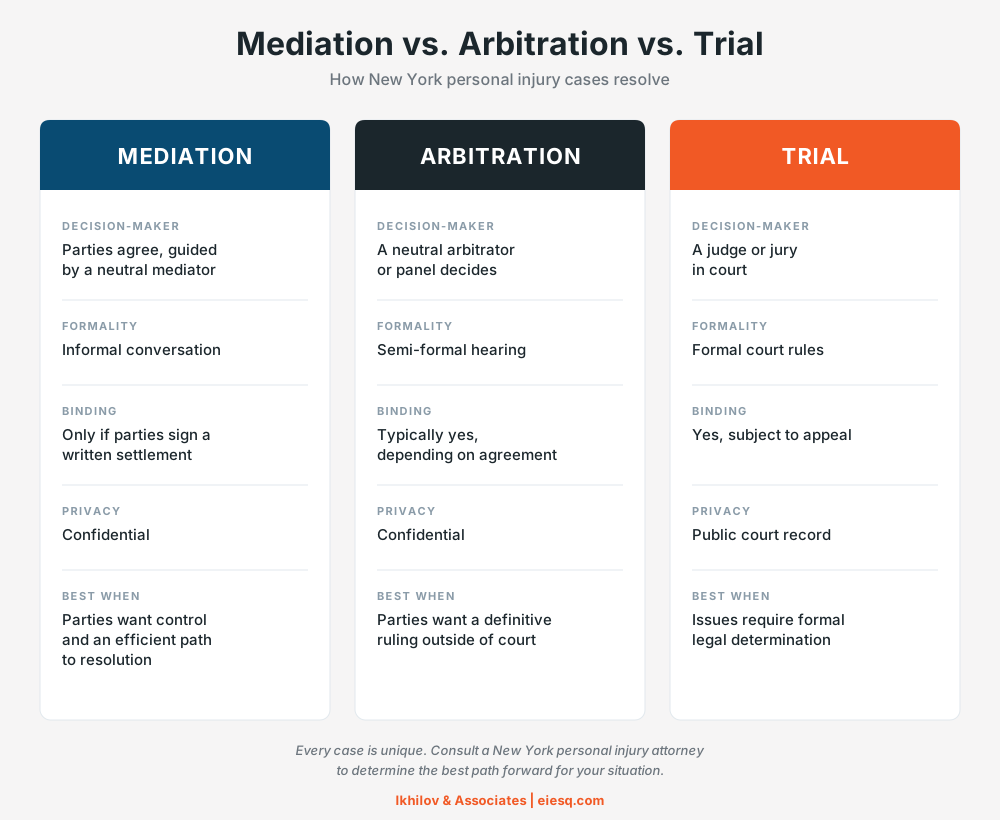
The graphic below compares mediation, arbitration, and trial at a glance. Each path has different decision-makers, formality, and privacy implications. Embed it on your site to share with clients or readers.
Embed this graphic on your site (free, attribution required)
Copy the HTML below. Attribution link to Ikhilov & Associates is required as a condition of use.
<a href="https://eiesq.com/glossary/ny-personal-injury-litigation-guide/" target="_blank" rel="noopener">
<img src="https://eiesq.com/wp-content/uploads/2026/06/mediation-vs-arbitration-ny-infographic.svg" alt="Mediation vs. Arbitration vs. Trial in NY Personal Injury Cases" style="max-width:100%;height:auto;" />
</a>
<p><small>Infographic by <a href="https://eiesq.com/glossary/ny-personal-injury-litigation-guide/">Ikhilov & Associates</a>, a New York personal injury law firm.</small></p>Most New York personal injury lawsuits go through mediation at some stage. Mediation is a voluntary, non-binding process where a neutral mediator (often a retired judge) helps the parties negotiate. Either side can walk away if no agreement is reached. Many cases settle at or shortly after mediation.
Arbitration is different. The arbitrator hears evidence and renders a decision that is typically binding and enforceable in court. New York requires arbitration for most no-fault insurance disputes through the American Arbitration Association.
For ordinary personal injury cases pending in Supreme Court, mediation is the more common pre-trial step. The mediator’s role is to help each side see the case as the other side sees it, surface settlement ranges, and bridge gaps that direct negotiation has not closed.
The New York Personal Injury Litigation Timeline
A typical New York personal injury lawsuit follows a predictable sequence:
- Investigation and demand (weeks to months): the lawyer gathers evidence, opens medical files, sends spoliation letters, identifies defendants and insurance, and often sends a settlement demand to the insurer.
- Filing the complaint: if no settlement is reached, the lawsuit is filed. New York’s general statute of limitations is three years from the date of injury, with shorter notice rules for claims against public entities.
- Pleadings (1 to 3 months): the defendant answers; preliminary motions may be filed.
- Discovery (6 to 18 months): document exchange, written interrogatories, depositions of parties and witnesses, physical examinations, and expert disclosures.
- Motion practice (variable): summary judgment motions on liability or the serious-injury threshold are common after discovery; favorable rulings often prompt settlement.
- Mediation (often before trial): court-ordered or voluntary mediation is the most common settlement vehicle.
- Trial (rare but real): a small percentage of New York personal injury cases go to verdict, but credible trial readiness is what drives settlement value.
For ordinary cases, two years from filing to resolution is common. Serious-injury and catastrophic cases regularly take longer. Cases against public entities or with multiple defendants typically take longer still.
Settlement vs. Trial
The vast majority of New York personal injury cases settle. A trial is expensive, time-consuming, and uncertain for both sides. But settlements happen because trial is a credible alternative. A case that signals it is willing to go all the way to verdict tends to settle for more than one that does not.
Reasons cases settle:
- The medical and liability picture is clear, and the parties agree on the range
- Insurance limits cap recovery either way
- The client wants closure and certainty
- Both sides see trial risk that is not worth the upside
Reasons cases go to trial:
- The defense believes the threshold is not met or liability is weak
- The defense’s settlement offer is below what the evidence supports
- Policy limits are high and the parties cannot agree on case value
- The case has unusual factual or legal questions
Related guides: For Labor Law 240 and construction site claims, see our New York construction worker rights guide. For pain and suffering, no-fault, and the serious injury threshold, see our New York car accident guide. To start a personal injury claim now, see our personal injury practice page.
Common Questions About New York Personal Injury Lawsuits
How much does it cost to hire a personal injury lawyer in New York?
Most New York personal injury lawyers, including this firm, work on a contingency-fee basis. There is no upfront fee. The lawyer is paid only if the case results in a recovery, as a percentage of that recovery.
How is the value of my case determined?
Case value reflects past and future medical expenses, lost earnings and earning capacity, property damage, and (if the threshold is met in motor-vehicle cases) pain and suffering. Liability clarity, available insurance limits, and the strength of the medical record all influence the practical range.
How long until I get paid after winning or settling?
Once a settlement is reached or a verdict is paid, funds typically arrive within several weeks. Court approval is required for some cases (minors’ settlements, wrongful death). Any liens (workers’ compensation, Medicare, Medicaid, ERISA plans) must be resolved before the client receives the net.
What if I lose at trial?
Under a contingency agreement, no attorney’s fee is owed. The case may also leave you responsible for some costs depending on the retainer; check the written agreement.
When should I hire a personal injury lawyer?
As soon as possible. Time-sensitive evidence can disappear within days. Statutes of limitations and notice deadlines (especially against public entities) can be short. Early legal help protects every applicable deadline and preserves the strongest evidence.
Talk to a New York Personal Injury Lawyer
If you were injured by another party’s negligence in New York, Ikhilov & Associates can evaluate every avenue of recovery. Consultations are free and there is no fee unless we win. Contact us to discuss your case, or learn more about our personal injury practice.