
New York protects construction workers more strongly than almost any other state. Two statutes drive that protection: Labor Law section 240(1), commonly called the Scaffold Law, and Labor Law section 241(6), which incorporates the New York Industrial Code. Together they often allow injured workers to recover compensation far beyond what workers’ compensation alone provides, particularly in cases involving falls, falling objects, or specific code violations.
This guide explains how these laws work, when each applies, how the workers’ compensation lien interacts with a separate lawsuit, and what real construction-accident recoveries from Ikhilov & Associates have looked like in New York. It is intended as general information; every case turns on its facts.
Labor Law Section 240(1), the Scaffold Law
New York Labor Law section 240(1), commonly called the Scaffold Law, imposes strict liability on owners and general contractors when a worker is injured by a gravity-related hazard on a construction, demolition, repair, alteration, painting, or cleaning project. Strict liability means the injured worker does not have to prove the owner or general contractor was careless. The focus is on whether adequate safety devices, such as scaffolds, ladders, hoists, slings, ropes, or harnesses, were in place and properly functioning.
The statute covers two main categories of injury:
- Falls from a height: a scaffold that collapses or sways, a ladder that slips, a worker on a roof or upper floor who falls because the protective system was inadequate.
- Falling objects: a worker on a lower level who is struck by a tool, material, or piece of equipment that was not properly secured at height.
Defenses are narrow. New York courts have rejected most arguments based on a worker’s carelessness, including failure to use safety devices that were not actually provided. The Court of Appeals has recognized a limited “sole proximate cause” defense, but it is hard to win for the defense because it requires showing the worker’s misconduct was the only cause of the injury.
The statute has a narrow exception for owners of one- and two-family residences who do not direct or control the work. Commercial owners and developers do not get that exception.
The Scaffold Law (an alternate name for section 240(1)) is among the strongest worker-protection statutes in the country. Many injured construction workers in New York can pursue both workers’ compensation and a separate Scaffold Law claim against the owner and general contractor.
Labor Law Section 241(6), Industrial Code Violations
Labor Law section 241(6) requires construction-site owners, general contractors, and their agents to comply with the specific safety rules in the New York State Industrial Code, codified at 12 NYCRR section 23. Unlike section 240(1), section 241(6) is not strict liability; it is fault-based and tied to a specific Industrial Code violation that proximately caused the injury.
Examples of Industrial Code requirements include:
- Walkways must be kept clear of debris
- Floor openings must be guarded
- Adequate lighting must be provided in work areas
- Temporary cabling must be elevated or protected
- Certain power tools require guards
Section 241(6) extends New York’s strong worker protections to situations outside the Scaffold Law. A worker who slips on debris in a passageway, a worker injured at an unguarded floor opening, or a worker hurt by an unguarded machine may all have viable claims under section 241(6) even if section 240(1) does not apply. Most construction-accident lawsuits in New York plead both statutes.
Workers’ Compensation vs. Third-Party Lawsuits
New York workers’ compensation provides medical benefits and a portion of lost wages, regardless of fault. The trade-off is that comp generally bars a direct lawsuit against the employer. Many injured workers assume comp is their only option. It often is not.
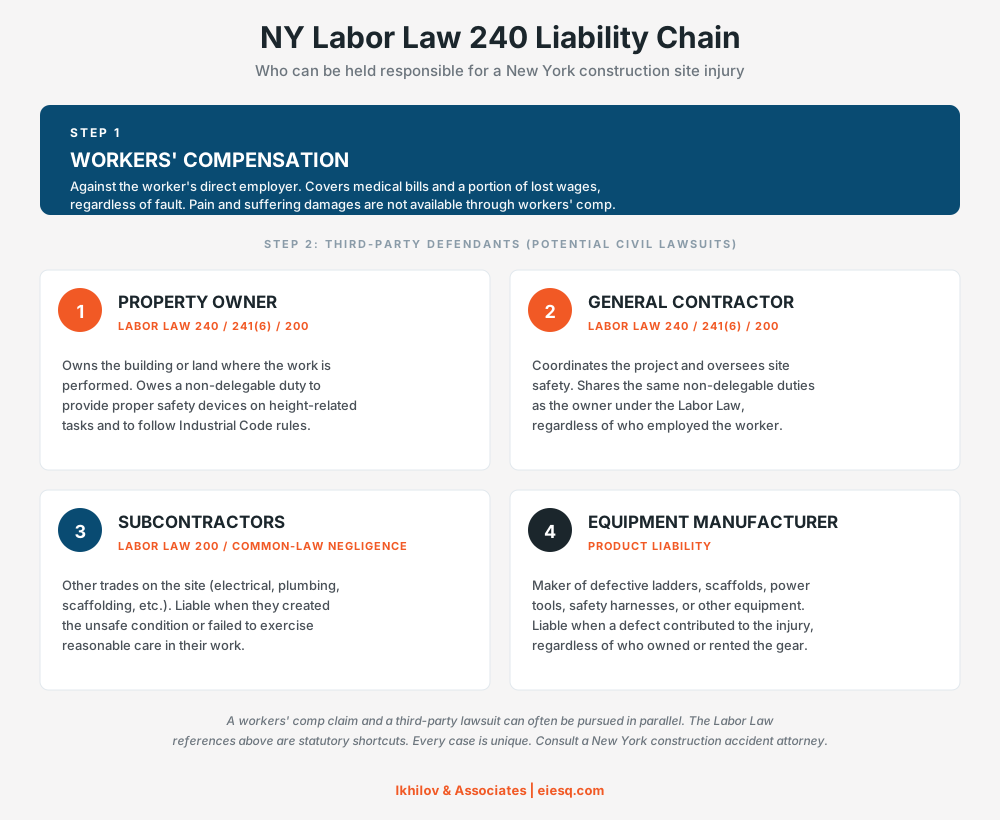
If someone other than the employer caused the injury, the worker can usually file a third-party lawsuit against that person or company. On a construction site, common third-party defendants include the property owner, the general contractor, subcontractors that did not employ the worker, equipment manufacturers, and product suppliers.
Workers’ compensation pays only part of the injured worker’s actual losses. It does not pay for pain and suffering. Lost-wage benefits are capped. A third-party lawsuit can recover the full value of these losses, often supporting recoveries many times larger than comp alone. The two tracks must be coordinated, and the comp lien addressed.
The Workers’ Compensation Lien
The graphic below maps who can be held responsible after a New York construction site injury, including workers compensation against the direct employer and the four main third-party defendants under Labor Law 240, 241(6), and 200. Embed it on your site to share with clients or readers.
Embed this graphic on your site (free, attribution required)
Copy the HTML below. Attribution link to Ikhilov & Associates is required as a condition of use.
<a href="https://eiesq.com/glossary/ny-construction-worker-rights/" target="_blank" rel="noopener">
<img src="https://eiesq.com/wp-content/uploads/2026/06/ny-construction-site-liability-infographic.svg" alt="New York Construction Site Liability Chain: who can be held responsible after a job-site injury, including workers compensation against the employer and four third-party defendants under Labor Law 240, 241(6), and 200" style="max-width:100%;height:auto;" />
</a>
<p><small>Infographic by <a href="https://eiesq.com/glossary/ny-construction-worker-rights/">Ikhilov & Associates</a>, a New York personal injury law firm.</small></p>Under New York Workers’ Compensation Law section 29, the comp carrier has a statutory right to be reimbursed from any third-party recovery for the benefits it paid. This is called the workers’ compensation lien.
The lien generally covers medical expenses and indemnity (wage replacement) benefits paid by the comp carrier. In a successful third-party lawsuit, the lien must be addressed before the recovery is disbursed.
New York law does not require the lien to be paid dollar-for-dollar. The Burns v. Varriale framework, codified at section 29(1), reduces the lien by the worker’s share of attorney’s fees and litigation costs. The lien can often be further reduced through negotiation, particularly when the third-party recovery is limited or the carrier’s future exposure is significant. In a typical serious case, the injured worker receives meaningful net proceeds after the lien is resolved.
Common New York Construction Accident Scenarios
- Scaffold collapse: a worker on a scaffold falls when a brace fails or the platform gives way. Often a clear section 240(1) case.
- Ladder fall: a worker falls when a ladder slips, is set on uneven ground, or is too short for the work.
- Falling object: a worker on a lower floor is struck by a tool, beam, brick, or fastener that was not secured at a higher level.
- Trench cave-in: a worker is trapped or injured in an excavation that was not properly shored or sloped. Often a section 241(6) claim.
- Crane or hoist failure: a worker is injured when a crane drops a load or strikes the worker. Can involve both 240(1) and product-liability claims.
- Electrocution: a worker is electrocuted by exposed wiring, an unmarked panel, or contact with an overhead line.
- Slip on debris: a worker slips on construction debris, water, or another hazard in a walkway. Often a section 241(6) claim tied to specific Industrial Code rules.
Related guides: For pain and suffering damages, the serious injury threshold, and no-fault rules, see our New York car accident guide. For contingency fees, the litigation timeline, and what to expect at settlement or trial, see our personal injury lawsuit guide. If you were hurt on a New York job site, also see our construction accident practice page.
Common Questions About New York Construction Worker Rights
Can I sue if I am already receiving workers’ compensation?
Yes, if a third party (someone other than your direct employer) was responsible for the injury. A third-party lawsuit against a negligent property owner, general contractor, subcontractor, or equipment manufacturer is separate from workers’ compensation and can recover pain and suffering and full lost earnings that comp does not pay.
Does my immigration status affect my New York construction injury claim?
No. New York’s Labor Law protections and personal injury rights apply regardless of immigration status. Your status is not a defense for a negligent owner or contractor.
What if my own actions contributed to the injury?
For Labor Law section 240(1) cases, comparative-negligence defenses are sharply limited. For section 241(6) and ordinary negligence cases, comparative-fault percentages reduce recovery proportionally under New York’s pure comparative-fault rule.
How long do I have to file a claim?
Most personal injury claims in New York must be filed within three years. Claims against a public entity usually require a notice of claim within 90 days. Workers’ compensation claims have their own filing deadlines.
What if I work for a small contractor without workers’ compensation?
You may still have a claim. Uninsured employers can sometimes be sued directly, the state Uninsured Employers Fund may pay benefits, and third-party claims against owners and general contractors generally do not depend on whether your direct employer carried comp.
Talk to a New York Construction Accident Lawyer
If you were hurt on a New York construction site, our construction accident attorneys handle the investigation, the insurance carriers, and the workers’ compensation lien so you can focus on healing. We work on a contingency basis, so there is no fee unless we win. Contact us for a free, confidential consultation.