
New York is a no-fault state, which makes its car-accident rules different from those in most other states. After a crash, your own auto policy usually pays first, regardless of fault, but the ability to sue the at-fault driver for pain and suffering depends on whether your injury crosses a specific statutory threshold. Understanding how these pieces fit together is the difference between a claim that recovers full value and one that stalls at the no-fault limit.
This guide explains how New York no-fault works, what the “serious injury threshold” means in practice, how pain and suffering damages are calculated, how comparative negligence affects recovery, and when uninsured or underinsured motorist coverage kicks in.
How New York No-Fault Insurance Works
New York is a no-fault state under Insurance Law section 5104. After a car accident, your own auto policy pays initial medical bills and a portion of lost wages, regardless of who caused the crash. This is intended to speed up payment for medical care without waiting for fault to be litigated.
Standard no-fault benefits, called Personal Injury Protection (PIP), generally include:
- Medical and rehabilitation expenses
- A portion of lost earnings, typically up to $2,000 per month for up to three years, subject to a statutory cap
- $25 per day for incidental expenses
- A $2,000 death benefit if the injured person dies from the accident
The standard PIP limit is $50,000 per person, although higher coverage may be available if it was purchased.
Pedestrians and cyclists struck by a motor vehicle are usually covered by the no-fault insurance of the striking vehicle. Passengers are usually covered by the no-fault insurance of the vehicle they were in.
No-fault has strict deadlines. The no-fault application (form NF-2) generally must be submitted to the insurer within 30 days of the accident. Medical providers have separate billing deadlines. Missing these deadlines can lead to denial of benefits even where treatment is clearly accident-related.
The Serious Injury Threshold (Insurance Law Section 5102(d))
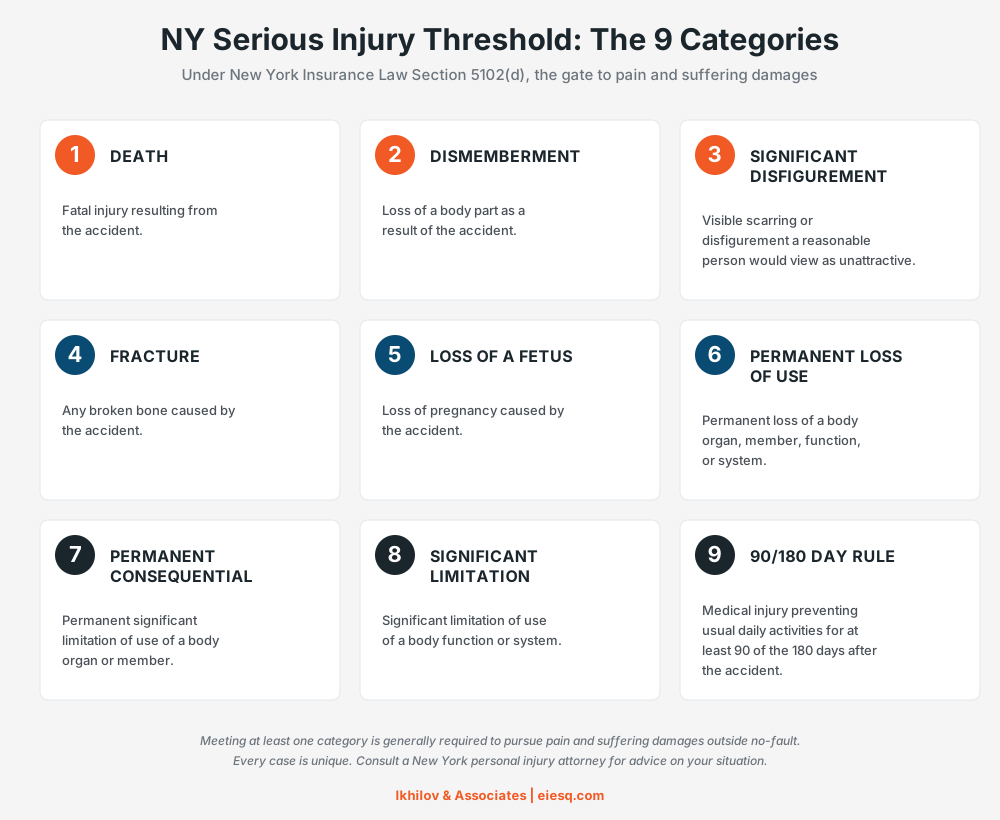
The graphic below maps the 9 statutory categories defined in NY Insurance Law Section 5102(d). Meeting at least one is generally required to pursue pain and suffering damages outside the no-fault system. Embed it on your site to share with clients or readers.
Embed this graphic on your site (free, attribution required)
Copy the HTML below. Attribution link to Ikhilov & Associates is required as a condition of use.
<a href="https://eiesq.com/glossary/ny-car-accident-legal-guide/" target="_blank" rel="noopener">
<img src="https://eiesq.com/wp-content/uploads/2026/06/ny-serious-injury-9-categories-infographic.svg" alt="The 9 categories of serious injury under New York Insurance Law Section 5102(d): the legal threshold required to pursue pain and suffering damages in NY car accident cases" style="max-width:100%;height:auto;" />
</a>
<p><small>Infographic by <a href="https://eiesq.com/glossary/ny-car-accident-legal-guide/">Ikhilov & Associates</a>, a New York personal injury law firm.</small></p>No-fault speeds up medical payment, but it also limits the right to sue the at-fault driver. To pursue pain and suffering against the at-fault driver, your injury must fit one of nine statutory categories under Insurance Law section 5102(d). This is called the serious injury threshold.
The nine categories are:
- Death
- Dismemberment
- Significant disfigurement
- Fracture
- Loss of a fetus
- Permanent loss of use of a body organ, member, function, or system
- Permanent consequential limitation of use of a body organ or member
- Significant limitation of use of a body function or system
- A medically-determined injury or impairment of a non-permanent nature that prevents the injured person from performing substantially all of the material acts that constitute their usual and customary daily activities for at least 90 of the 180 days following the accident
Defendants frequently file summary-judgment motions challenging whether the threshold is met, supported by reports from independent medical examinations (IMEs). The court decides the threshold issue at summary judgment; if the case survives, a jury can also decide the threshold question at trial.
Strong medical documentation matters enormously: diagnostic imaging, treatment records, range-of-motion measurements, treating-physician affirmations addressing the specific statutory categories, and the continuity of treatment. Gaps in treatment or premature claims of resolution can undermine a threshold argument later in the case.
Pain and Suffering Damages
If your injury meets the serious-injury threshold, you can sue the at-fault driver for pain and suffering in addition to recovering economic damages. Pain and suffering is a non-economic category that compensates for physical pain, mental anguish, loss of enjoyment of life, and emotional distress.
New York uses no single statutory formula. Juries and adjusters consider:
- The severity and permanence of the injury
- The medical record (surgery, ongoing treatment, prognosis)
- The injured person’s age and life expectancy
- The practical effect on daily life, including work, hobbies, and family
- Comparable verdicts from similar New York cases
Available insurance limits, the strength of the medical documentation, and any prior conditions all influence the practical range of recovery. New York has no general statutory cap on pain and suffering in personal injury cases, unlike some other states.
Comparative Negligence in New York Car Accident Cases
New York follows a pure comparative-negligence rule under CPLR section 1411. An injured plaintiff’s recovery is reduced by their percentage of fault, but they are not barred from recovery even if they were more than half at fault. This is one of the most plaintiff-friendly comparative-fault rules in the country.
Examples:
- A driver was 20% at fault for a crash; a jury awards $200,000. Recovery is $160,000.
- A pedestrian jaywalked outside a marked crosswalk and was struck by a driver looking at a phone. The jury finds the pedestrian 40% at fault on a $100,000 verdict. Recovery is $60,000.
- A motorist was speeding when another vehicle ran a red light. The jury finds the speeding motorist 70% at fault on a $200,000 award. Recovery is still $60,000.
Because New York does not have a 50% bar, even mostly-at-fault plaintiffs can recover. Defendants regularly argue comparative fault to reduce damages. Strong liability evidence (police reports, surveillance video, witness statements, accident reconstruction) is the most effective response.
Uninsured and Underinsured Motorist Coverage
If the at-fault driver has no insurance, fled the scene, or has insufficient coverage to fully pay your damages, your own uninsured motorist (UM) or supplementary underinsured motorist (SUM) coverage may step in.
UM/SUM claims have strict procedural rules:
- Prompt notice to your insurer is critical (often within 90 days of the accident)
- Police reports establishing the at-fault driver’s identity or lack of insurance are central
- UM/SUM claims are typically resolved through arbitration rather than litigation
SUM coverage applies when the at-fault driver carries some insurance but less than your own SUM limits. Your policy makes up the difference, up to your SUM limit. A careful review of your own auto policies, and any household policies that may apply, is often part of a serious car-accident claim.
Related guides: For Labor Law 240, the scaffold law, and construction worker rights, see our New York construction worker rights guide. For contingency fees, mediation, and the litigation process, see our personal injury lawsuit guide. If you were hurt in a New York crash, also see our car accident practice page.
Common Questions About New York Car Accident Law
How long do I have to file a car accident claim in New York?
The general personal injury statute of limitations in New York is three years from the date of the accident. Claims against a public entity usually require a notice of claim within 90 days. UM/SUM claims have separate notice rules under the auto policy.
What if the other driver fled the scene?
Hit-and-run accidents are typically handled through uninsured motorist coverage. Report the hit-and-run to the police promptly, notify your insurer, and seek medical care. UM coverage is the most reliable path to compensation when the driver is unidentified.
Can I still sue if I have no-fault insurance?
Yes, if your injury meets the serious-injury threshold under Insurance Law section 5102(d). The no-fault system pays initial medical and lost-wage benefits regardless of fault, but pain-and-suffering damages from the at-fault driver require crossing that threshold.
What happens if I was partially at fault for the accident?
Under New York’s pure comparative-negligence rule, your recovery is reduced by your percentage of fault but not barred. Even a plaintiff found mostly at fault can recover a proportional share of damages.
How long does a New York car accident case typically take?
It varies. Straightforward soft-tissue cases can settle in a few months once treatment plateaus. Serious-injury cases that require extensive medical documentation or trial preparation often take a year or more.
Talk to a New York Car Accident Lawyer
If you were injured in a car accident in New York, our car accident attorneys coordinate your no-fault benefits, evaluate the serious-injury threshold, identify every applicable insurance policy, and pursue full compensation from the at-fault driver. We work on a contingency basis, so there is no fee unless we win. Contact us for a free, confidential consultation.