
What Insurance Covers Bicycle Accidents? Proving Brooklyn Dooring Claims
Published:
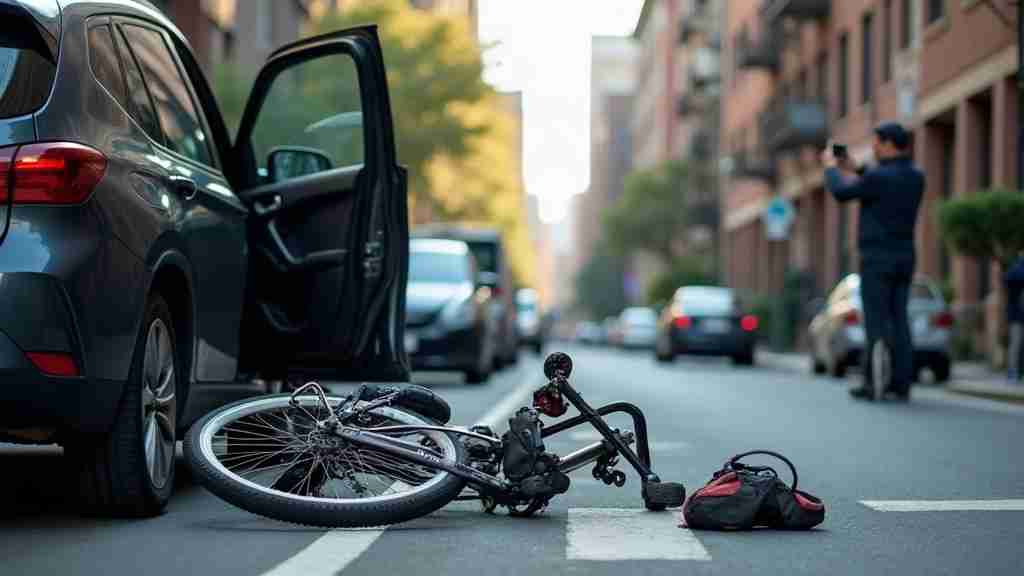
Dooring accidents happen when a driver or passenger opens a car door into the path of a cyclist, often without looking first. These crashes are among the hardest bicycle claims to prove in Brooklyn because there’s rarely a crash between moving vehicles to analyze, witnesses often scatter quickly, and the at-fault party frequently claims the door was already open or the cyclist “came out of nowhere.” Before getting into why these cases are so difficult, it helps to understand what insurance covers bicycle accidents in the first place, since the coverage questions are just as tangled as the fault questions.
In New York, a dooring victim may have several potential sources of recovery: the driver’s auto liability policy, their own no-fault coverage if they have an auto policy, and in some cases a homeowners or renters policy belonging to the person who opened the door. Figuring out which policy applies — and getting that insurer to actually pay — is where many dooring claims stall.
What Insurance Covers Bicycle Accidents in a Dooring Crash?
When a parked car’s door strikes a cyclist, the vehicle’s auto insurance is typically the first place a claim goes. New York law specifically prohibits opening a car door into traffic without first checking that it’s safe, and a violation of that rule is strong evidence of negligence.
Here’s how coverage generally breaks down in a Brooklyn dooring case:
- The at-fault driver’s or passenger’s auto liability policy — If the door was opened by the vehicle’s owner or occupant, the car’s liability coverage usually applies, since the vehicle was involved in causing the injury.
- Your own no-fault (PIP) coverage — If you own a car and carry New York no-fault insurance, it may cover your initial medical bills and some lost wages regardless of fault, even though you were riding a bicycle rather than driving.
- Uninsured/underinsured motorist coverage — If the driver who opened the door has no insurance or insufficient coverage, your own policy’s UM/UIM provision may step in.
- MVAIC (Motor Vehicle Accident Indemnification Corporation) — For cyclists who don’t own a car and have no household auto policy, this state fund can sometimes provide a safety net when the at-fault party is uninsured.
Because dooring technically involves a parked vehicle rather than a car “in motion,” some insurers try to argue the claim doesn’t fit standard auto liability definitions. This is one of the first points where a knowledgeable bicycle accidents attorney can push back, since New York courts have generally treated dooring as an auto-related incident for coverage purposes.
Does Homeowners Insurance Cover Bicycle Accidents?
This question comes up often, and the honest answer is: it depends on the situation. Does homeowners insurance cover bicycle accidents when a door is involved? Generally, no — if the injury results directly from a car door striking a cyclist, that’s considered an auto-related incident, and most homeowners or renters policies specifically exclude injuries arising from the use of a motor vehicle.
That said, there are edge cases. If a passenger or driver’s conduct is considered separate from “use” of the vehicle — for example, if someone intentionally shoved a door open as a prank, or a dispute arises over an action unrelated to vehicle operation — a homeowners or umbrella policy could theoretically come into play. These scenarios are uncommon and heavily fact-dependent.
So while the broader question of does home insurance cover bicycle accidents doesn’t have a single universal answer, for a typical dooring incident, the answer leans strongly toward auto insurance being the relevant policy, not a homeowners or renters policy.
Why Dooring Claims Are Uniquely Difficult to Prove
Dooring cases create a perfect storm of evidentiary problems that distinguish them from a typical rear-end collision or intersection crash. Several factors make these claims especially tough in Brooklyn’s dense streets.
No Vehicle-to-Vehicle Impact to Analyze
Collision reconstruction experts rely heavily on vehicle damage, skid marks, and crush patterns to determine speed and fault. A dooring incident usually leaves minimal damage to the car itself, and there’s no second vehicle’s movement to cross-reference. The physical evidence often comes down to scuff marks on the door, damage to the bicycle, and the rider’s injuries.
Disputes Over Who Opened the Door
In a parked car with multiple occupants, it’s not always clear whether the driver or a passenger opened the fatal door. Liability can shift depending on who is found responsible, and insurers sometimes use this ambiguity to delay or deny a claim while fault gets sorted out.
The “Door Was Already Open” Defense
A common tactic is claiming the door had been open for some time and the cyclist simply failed to see it or swerved unnecessarily close. Without video footage or a disinterested witness, this becomes a credibility battle between the cyclist’s account and the vehicle occupant’s account.
Witnesses Who Don’t Stick Around
Dooring incidents often happen on residential or commercial blocks where pedestrians are moving quickly and don’t realize they witnessed anything significant. By the time a cyclist can even process what happened, let alone ask for contact information, bystanders have often moved on.
Limited or No Traffic Camera Coverage
Intersection cameras are common throughout New York City, but mid-block parking lanes — exactly where dooring happens — are far less likely to be covered. Nearby storefront or residential cameras can sometimes fill the gap, but footage is often deleted within days or weeks if not requested promptly.
Comparing Dooring Claims to Standard Bicycle-Vehicle Collisions
| Factor | Standard Vehicle Collision | Dooring Accident |
|---|---|---|
| Physical evidence | Skid marks, vehicle crush damage, debris field | Minimal vehicle damage, mostly bicycle/rider injuries |
| Fault determination | Often clearer from traffic signals, right-of-way rules | Often disputed; depends on who opened the door and when |
| Camera coverage | Frequently captured at intersections | Rarely captured on mid-block parking lanes |
| Applicable law | Standard rules of the road | New York’s “safe opening of doors” statute |
Steps That Strengthen a Dooring Claim
Because these cases depend so heavily on quickly gathered evidence, what happens in the minutes and days after a dooring crash matters enormously.
- Photograph everything immediately — the door’s position, the bicycle’s final resting place, skid or scrape marks, and the surrounding parking lane.
- Get the names of any bystanders, even if they only saw the aftermath rather than the moment of impact.
- Request nearby business or residential camera footage as soon as possible, before it’s overwritten.
- File a police report and make sure the responding officer notes which occupant opened the door.
- Seek medical attention right away, even for injuries that seem minor at first, since dooring crashes frequently cause falls that lead to wrist fractures, shoulder injuries, or head trauma.
Cyclists who suffer more serious harm — a head injury from being thrown from the bike, a fractured spine, or nerve damage — should also understand how these injuries are evaluated in a legal claim. Our pages on traumatic brain injuries and spinal cord injuries go into more depth on how catastrophic injury claims are built and valued.
Why Brooklyn’s Streets Make Dooring Especially Common
Brooklyn’s mix of narrow residential streets, heavy alternate-side parking, and growing bike lane network creates frequent close contact between parked cars and cyclists. Many bike lanes run directly alongside parking lanes rather than being physically separated, which puts riders squarely in the “door zone.” Delivery drivers, rideshare pickups, and double-parked vehicles add even more unpredictable door-opening moments throughout the day.
This local reality is part of why dooring claims deserve careful, prompt handling rather than being treated like a routine fender-bender. The compressed timeline for preserving video evidence and locating witnesses means early legal guidance can make a real difference in how the claim unfolds.
When to Involve a Bicycle Accidents Lawyer
Given how quickly evidence disappears and how aggressively insurers dispute fault in these cases, involving a bicycle accidents lawyer early is often the difference between a denied claim and a fairly compensated one. An attorney can send preservation letters for camera footage, track down witnesses through canvassing, and push back against coverage denials rooted in the “not a moving vehicle” argument.
These cases also frequently intersect with other claim types. A cyclist who swerves to avoid a door and is then struck by a passing car may have both a dooring claim and a separate collision claim to sort out, which is where broader experience with car accident claims and New York’s layered insurance system becomes valuable.
Getting the Right Guidance After a Dooring Incident
Dooring accidents sit in an uncomfortable gap between auto insurance and homeowners coverage, between clear fault and disputed fault, and between evidence that’s easy to gather and evidence that vanishes within days. Understanding what insurance covers bicycle accidents — and recognizing why homeowners policies rarely apply — is the first step toward protecting a fair claim.
If you’ve been hurt in a dooring incident in Brooklyn or anywhere nearby, Ikhilov & Associates can review what happened, identify every available source of coverage, and help you understand your options before evidence disappears. You can learn more about our approach to these cases on our personal injury page, read more about our firm on Google, or reach out whenever you’re ready to talk through your situation.

Keep reading
More from the blog

How to Prevent Workplace Injuries: Why RSI Claims Get Denied in Brooklyn
Learn how to prevent workplace injuries like carpal tunnel and back strain, and why repetitive stress claims are…
Read more
Why Scaffold Law Cases Differ From Standard Construction Injury Claims
A construction accidents lawyer chicago il searchers trust explains why Scaffold Law claims differ from standard construction injury…
Read more
What Are the Main Causes of Pedestrian Accidents in Brooklyn?
What are the main causes of pedestrian accidents in Brooklyn? Learn why left-turn collisions, distracted driving, and poor…
Read moreTalk to a lawyer about your case
A case review costs nothing and puts you under no obligation. We work on a contingency fee, so there is no fee unless we recover compensation for you.